
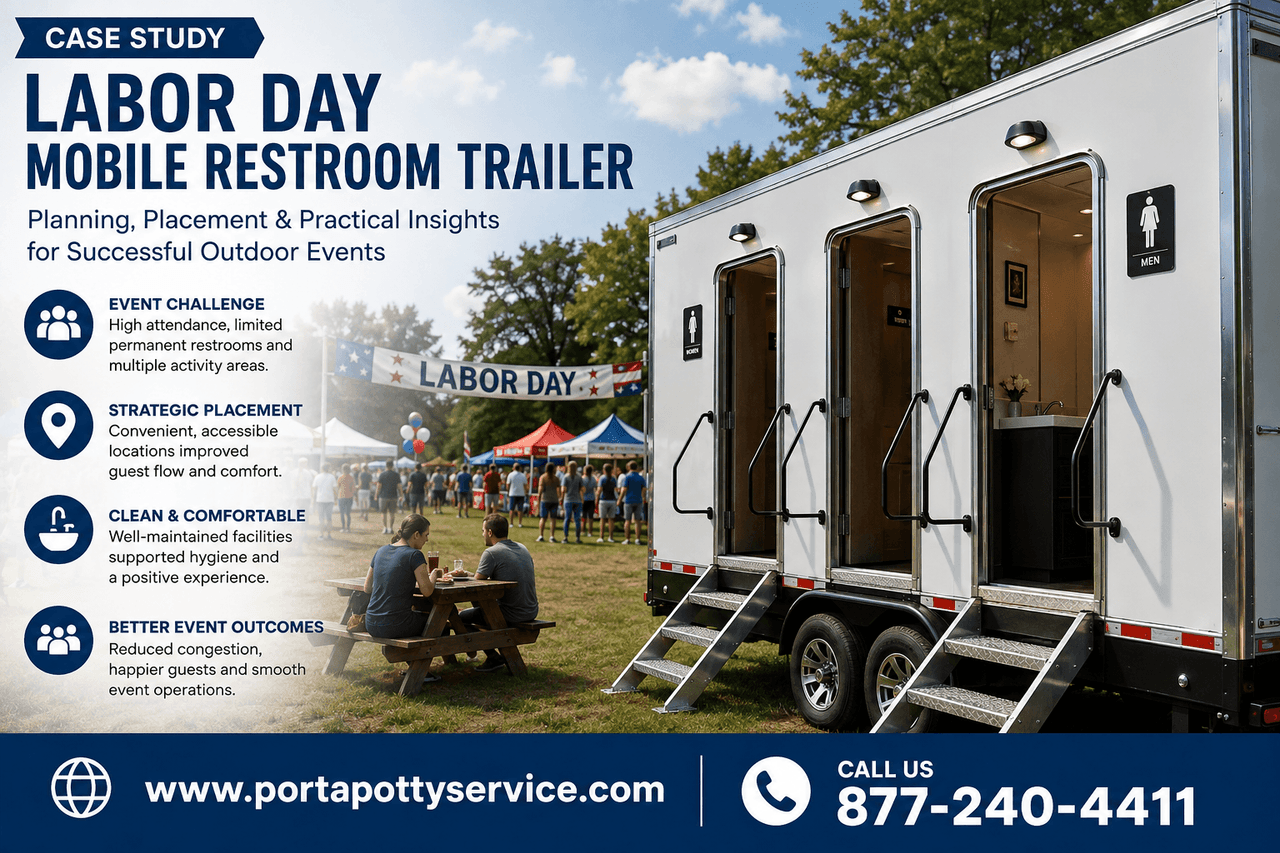
Labor Day Mobile Restroom Trailer: A Case Study in Event Sanitation Planning
Introduction
Labor Day marks the unofficial end of summer in the United States and is often associated with community gatherings, outdoor festivals, family celebrations, sporting activities, fairs, and workplace events. Because many of these activities take place outdoors, organizers must consider sanitation facilities as an important part of event planning.
This case study examines the role of a Labor Day mobile restroom trailer during a large outdoor gathering. The objective was not simply to provide additional restrooms, but to understand how restroom placement, capacity, cleanliness, accessibility, and visitor flow could influence the overall experience of an event.
Event Background
The Labor Day gathering was planned as a full-day outdoor community event. Activities included food areas, children's entertainment, live performances, games, and several seating zones. Attendance was expected to increase throughout the afternoon, creating a need for restroom facilities that could accommodate changing visitor volumes.
The event location presented an additional challenge. The property had limited permanent restroom facilities, and the available buildings were positioned too far from several activity areas. Relying exclusively on existing facilities could have resulted in long walking distances and unnecessary crowding.
As part of the event planning process, organizers evaluated the use of a mobile restroom trailer as a temporary sanitation solution.
Identifying the Sanitation Challenge
The first concern was estimating how many people would use restroom facilities during the event. Attendance numbers alone were not enough to determine restroom demand. The length of the event, food and beverage consumption, weather conditions, age groups, and the presence of families all had to be considered.
Another concern involved visitor movement. If all restroom facilities were concentrated in one location, people from distant parts of the event grounds would have to travel farther. This could create congestion around popular activity areas.
Organizers therefore considered restroom placement as part of the overall site layout rather than treating sanitation as a separate issue.
Planning the Mobile Restroom Trailer
The mobile restroom trailer was incorporated into the event plan before the gathering began. Its location was selected based on accessibility, pedestrian traffic, available space, and proximity to major activity areas.
The placement also needed to allow service access without interfering with visitors. A location that was convenient for attendees but difficult for maintenance vehicles would create operational problems.
Ground conditions were another consideration. The trailer needed a reasonably stable surface with suitable access. Organizers also considered connections and service requirements associated with the temporary facility.
The planning process demonstrated that restroom placement involves more than finding an open area. It requires coordination with the complete event layout.
Importance of Interior Capacity and Layout
Unlike a basic temporary toilet, a mobile restroom trailer provides an interior environment designed to accommodate multiple users. For a Labor Day gathering with families and guests of different ages, the internal layout became an important consideration.
The arrangement of individual restroom areas, sinks, mirrors, lighting, and walking space influenced how efficiently visitors could move through the trailer.
During periods of increased attendance, an organized interior layout helped reduce unnecessary waiting and made it easier for guests to enter and exit without disrupting the surrounding event area.
The case also demonstrated that sanitation facilities should be evaluated according to the type of gathering. A family-oriented event may have different requirements from a construction site, concert, or sporting competition.
Cleanliness and Maintenance
Cleanliness was one of the most important operational factors throughout the Labor Day event.
Because the gathering lasted for several hours, restroom usage changed continuously. A facility that appeared clean at the beginning of the day could require attention later as visitor numbers increased.
A maintenance schedule was therefore incorporated into the event plan. Supplies such as soap, paper products, and other restroom necessities were monitored. High-traffic periods received particular attention.
This approach highlighted an important lesson: providing a restroom facility is only one part of sanitation planning. Ongoing monitoring is equally important when a temporary facility is serving a large group of people.
Accessibility Considerations
Accessibility was another central part of the planning process. Event organizers needed to ensure that restroom facilities could be reached by guests with different mobility requirements.
The route leading to the restroom trailer was considered along with the surrounding surface conditions. Clear access helped prevent unnecessary obstacles for visitors.
Accessibility planning also reinforced the importance of considering all attendees during event preparation. Temporary facilities should not be positioned solely according to convenience for the majority of guests.
Managing Visitor Flow
As attendance increased during the afternoon, restroom traffic became more noticeable. Visitors naturally moved toward facilities during breaks between activities and performances.
The location of the restroom trailer helped distribute pedestrian movement across the event grounds. Rather than forcing every visitor toward one permanent restroom area, the temporary facility provided an additional point for sanitation needs.
This reduced pressure on existing facilities and helped maintain smoother movement throughout the site.
The observation showed that restroom planning can influence crowd management. Sanitation facilities are therefore connected to broader event logistics, including pedestrian circulation and activity scheduling.
Lessons From the Labor Day Event
Several lessons emerged from the case study.
First, restroom requirements should be considered early in event planning. Waiting until the final stages can make it difficult to find appropriate space or coordinate service access.
Second, expected attendance should be evaluated alongside event duration and visitor demographics. A numerical attendance estimate alone may not accurately represent restroom demand.
Third, placement matters. Facilities should be convenient without creating congestion or interfering with entertainment, food preparation, emergency access, or other important areas.
Fourth, cleanliness requires ongoing attention. Temporary restrooms can experience heavy use during peak periods, making monitoring and maintenance an essential part of event operations.
Finally, accessibility should be included from the beginning. A successful outdoor event needs facilities that can be reached and used by a broad range of attendees.
Conclusion
The Labor Day mobile restroom trailer in this case study demonstrated how temporary sanitation facilities can become an important component of outdoor event planning. The experience involved more than providing additional toilets; it required consideration of capacity, location, accessibility, cleanliness, maintenance, visitor movement, and overall site coordination.
Labor Day gatherings often bring together large groups in locations where permanent infrastructure may be limited. Careful sanitation planning helps organizers anticipate changing restroom demand and integrate temporary facilities into the event environment.
The case ultimately showed that effective restroom planning is closely connected to the comfort, accessibility, organization, and smooth operation of an outdoor celebration. By considering sanitation requirements alongside other logistical elements, event organizers can create a more structured environment for guests while reducing avoidable operational challenges.