
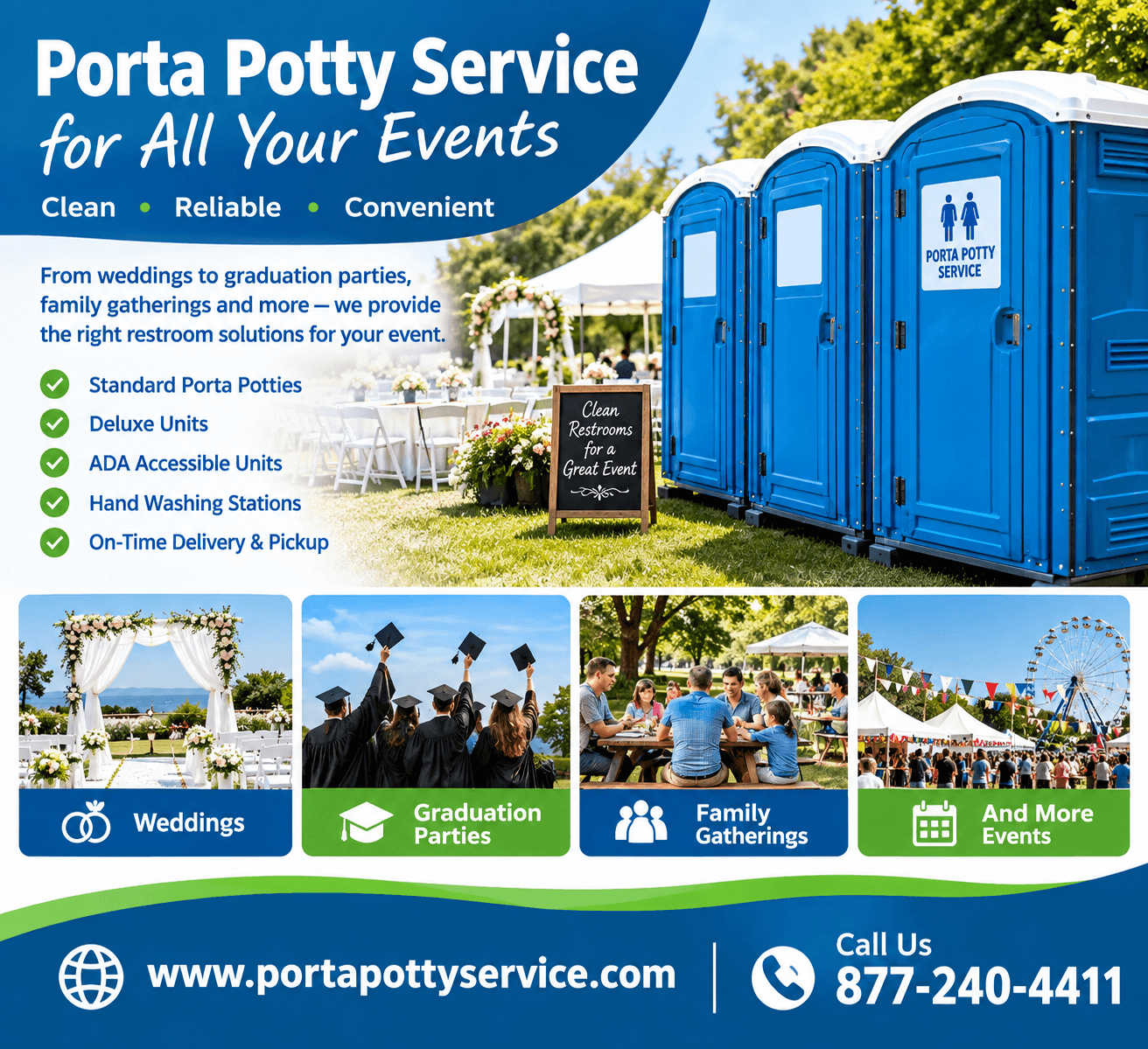
A to Z Porta Potty Service for Events: Wedding, Graduation Parties, and Family Gatherings
Introduction
Outdoor events bring people together for celebrations, ceremonies, reunions, and special occasions. Whether it is a wedding, graduation party, family gathering, community celebration, birthday party, festival, or corporate event, restroom planning is an important part of organizing a comfortable environment for guests.
When an event takes place at a park, private property, outdoor venue, open field, or temporary location, existing restroom facilities may not be sufficient. Portable restrooms can provide an additional sanitation option without requiring permanent restroom construction. This case study looks at how portable toilet planning can be approached from start to finish for different types of events.
The Event Planning Challenge
A family event coordinator was preparing a series of outdoor gatherings throughout the year. The events included a wedding reception, a graduation celebration, a large family reunion, and several smaller community gatherings.
The venues had different layouts and restroom situations. Some locations had permanent restrooms, while others had limited facilities or none available near the main activity areas.
The primary challenge was to determine the appropriate number and type of portable restrooms while considering guest attendance, event duration, location, accessibility, and placement.
Step 1: Understanding the Event
The first step was to collect basic information about each event.
Important details included:
Expected number of guests
Event duration
Start and end times
Indoor or outdoor location
Availability of permanent restrooms
Number of children and older guests
Whether food and beverages would be served
Accessibility requirements
Location of parking and activity areas
Available space for restroom placement
A wedding with several hundred guests may have different restroom requirements from a short graduation party with fewer attendees. Understanding the event before selecting equipment helped create a more practical plan.
Step 2: Wedding Event Planning
The wedding presented additional considerations because guests would spend several hours at the venue. The restroom area needed to be reasonably convenient without becoming the visual focus of the celebration.
Portable restrooms were considered for placement near, but not immediately beside, the main dining and ceremony areas. Attention was also given to pathways, lighting, parking access, and the movement of guests.
For a formal wedding, restroom options can include standard portable toilets, accessible units, and upgraded restroom units depending on the venue and event requirements.
Step 3: Graduation Party
The graduation celebration had a different setup. Guests included students, parents, relatives, and friends, with activities spread across an outdoor property.
The planning focused on placing portable restrooms where guests could reach them without walking through areas designated for food, photographs, or entertainment.
Because graduation parties can include younger guests and families, organizers also considered accessibility and convenient placement.
Step 4: Family Gathering
The family gathering involved multiple generations and lasted most of the day. Older adults and children were expected to attend, making restroom accessibility particularly important.
The planning team evaluated walking distances and selected locations that could be reached easily from the main gathering area.
The event also included food service and outdoor activities. Restrooms were positioned away from food preparation areas while remaining easy for guests to locate.
Step 5: A-to-Z Event Preparation
For each event, the planning process followed a basic sequence:
A – Assess: Review the venue and expected attendance.
B – Budget: Establish the available event sanitation budget.
C – Count: Estimate restroom requirements based on attendance and duration.
D – Determine: Identify the appropriate restroom types.
E – Examine: Check the proposed placement area.
F – Facilities: Consider accessibility and handwashing needs.
G – Guests: Consider the needs of different age groups.
H – Hygiene: Plan for sanitation and servicing.
I – Inspect: Confirm the units and placement before guests arrive.
J – Journey: Make sure guests can reach the units safely.
K – Keep Clear: Maintain unobstructed access.
L – Layout: Coordinate placement with the overall event layout.
M – Maintenance: Establish servicing requirements for longer events.
N – Number: Confirm the final quantity needed.
O – Organize: Coordinate delivery and pickup timing.
P – Placement: Position units on suitable, stable surfaces.
Q – Quality Check: Review the setup before the event begins.
R – Restrooms: Provide the selected portable restroom units.
S – Sanitation: Include handwashing and hygiene considerations.
T – Timing: Coordinate delivery and removal schedules.
U – Understand: Review venue-specific restrictions.
V – Verify: Confirm everything before guest arrival.
W – Walkways: Keep routes clear and accessible.
X – eXamine: Conduct a final site check.
Y – Your Guests: Consider comfort and convenience.
Z – Zero Surprises: Finalize the plan before the event day.
Results of the Planning Approach
Using the same structured process for each event helped the organizers identify differences between venues rather than relying on a single restroom plan.
The wedding required attention to guest comfort and venue presentation. The graduation party required convenient access for families and younger guests. The family gathering required consideration for multiple generations and longer event hours.
The case study demonstrated that portable restroom planning is not simply about placing units at an event. The venue, attendance, duration, accessibility, sanitation, placement, and event activities all influence the overall setup.
Conclusion
Porta potty service can be an important part of planning events where permanent restroom facilities are limited or unavailable. Weddings, graduation parties, family gatherings, festivals, reunions, outdoor celebrations, and community events can each have different sanitation requirements.
A successful event restroom plan begins with understanding the venue and guests, selecting suitable units, determining an appropriate quantity, choosing practical placement locations, and coordinating delivery, servicing, and pickup.
By treating restroom planning as part of the overall event preparation—from A to Z—organizers can create a more organized and comfortable environment for everyone attending.